
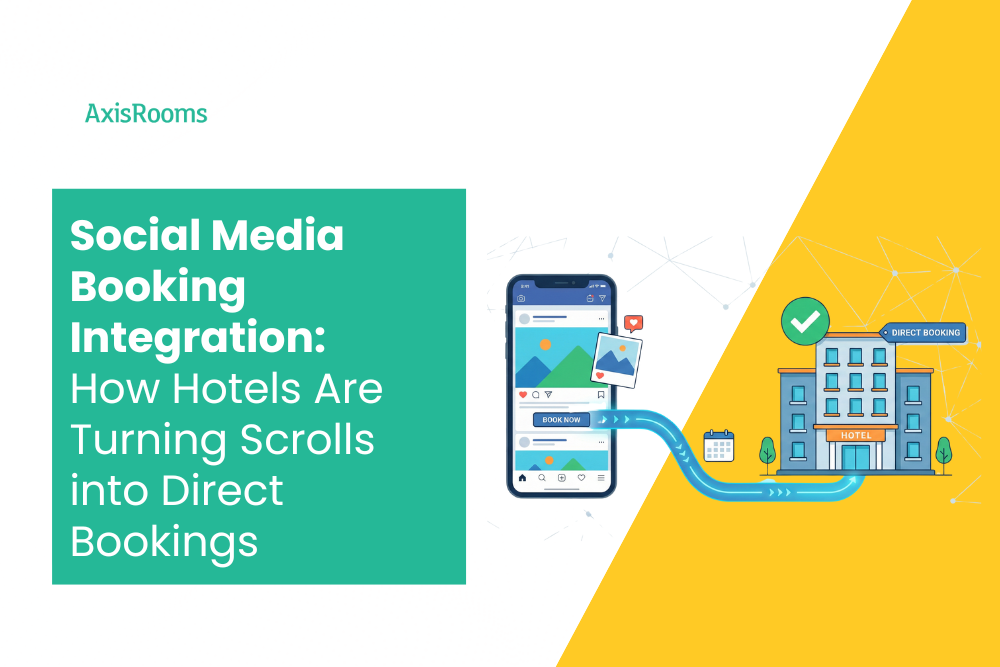

In 2026, the way travelers discover and book hotels is changing faster than ever. Social platforms are no longer just sources of inspiration; they are becoming active decision points in the booking journey. As mobile-first behavior continues to dominate, guests expect to move from browsing to booking without friction.
This shift is happening alongside rapid growth in digital travel commerce. In 2024, the global online travel market was valued at $523 billion and is projected to reach $1.3 trillion by 2030, growing at an annual rate of 13.1%. For hotels, this growth brings both opportunity and pressure.
In this blog, we explain what social media booking integration is, why it matters in 2026, the key benefits for hotels, and how AxisRooms helps turn social engagement into confirmed direct bookings.
TL;DR
- Social platforms are becoming booking channels, not just marketing tools
- In-app booking reduces friction and drop-offs
- Hotels can capture more impulse-driven direct bookings
- Real-time PMS and inventory sync are essential
- AxisRooms enables social bookings without adding operational complexity
What Is Social Media Booking Integration?
Social media booking integration allows hotels to accept direct reservations from platforms like Instagram, Facebook, and TikTok using booking links or buttons embedded within posts, stories, or ads.
At a high level, this means there are no redirects to third-party pages, rates and availability are shown in real time, and every booking syncs automatically with the hotel’s PMS and channel manager.
One-line flow: Social post → booking CTA →booking engine → PMS update
For hotels, this removes friction at the most critical moment when guest intent is highest.
Why Social Commerce Matters for Hotels in 2026
Travel decisions now start on social platforms. Guests discover destinations, hotels, and experiences while scrolling, watching short videos, or following creators they trust. When booking requires leaving the app, friction increases, and hotels lose impulse demand.
This matters more as online booking continues to scale. The online travel booking platform market is forecast to increase by USD 2,266.6 billion between 2024 and 2029, growing at a 20.6% CAGR. As competition intensifies, hotels that shorten the booking journey gain a clear advantage.
For hotels, social commerce enables:
- Fewer booking drop-offs with in-app checkout
- Higher conversion from impulse-driven demand
- Better control over distribution mix
- Reduced dependence on OTAs for social-driven demand
- Direct ownership of guest data and relationships
Direct bookings on social media for hotels become more than just a concept; they become a measurable revenue driver.
6 Key Benefits of Social Media Booking Integration for Hotels
Social media booking integration delivers measurable advantages for hotels in 2026:
- Shorter booking journeys - Guests move from inspiration to confirmation without leaving the app.
- Higher direct booking conversion - Fewer redirects mean fewer drop-offs and better ROI from social traffic.
- Reduced OTA dependency for social demand - Hotels capture impulse bookings directly instead of losing them to OTAs.
- Stronger visibility on social platforms - Booking-enabled content is favored by platform algorithms and discovery feeds.
- Mobile-first guest experience - Optimized for how travelers browse, decide, and book today.
- Clear tracking and attribution - Hotels can measure which posts, creators, or campaigns drive real bookings.
How Social Platforms Are Becoming Booking Channels
Social platforms are actively investing in commerce features that shorten the path from discovery to booking. For hotels, this means social is no longer just a marketing layer; it’s becoming a functional booking channel.
Social platforms are investing in commerce because it keeps users engaged longer and increases transaction value. For hotels, this directly enables shorter booking journeys, higher conversion, and stronger visibility, all without forcing guests to leave the app.
The Role of Short-Form Content, Creators, and Younger Travelers
Younger travelers, especially Gen Z and Millennials, book where they browse. Short-form video has become the most influential format for travel discovery, whether it’s a room tour, a property walkthrough, or a real guest experience.
Authentic content builds trust faster than polished ads. Influencers and creators now play a direct role in conversion, not just awareness. This trend is accelerating as influencer marketing grows. By the end of 2025, the influencer marketing industry is projected to reach $32.55 billion, up from $21.1 billion in 2023.
For hotels, this means creator partnerships and user-generated content can drive real bookings if the booking path is frictionless and direct.
Why Real-Time Sync and Analytics Matter
Social bookings fail without strong backend integration. If rates or availability shown on social platforms don’t match what’s in the PMS, guest experience suffers immediately.
This is why hotel PMS social integration is critical. Real-time sync ensures that inventory, pricing, and confirmations remain accurate across all booking touchpoints. Without it, hotels risk overbookings, manual corrections, and lost trust.
Analytics matter just as much. Hotels need visibility into which posts, platforms, or creators are generating bookings, not just likes or views. Attribution allows teams to optimize campaigns and justify investment in social commerce.
Why AxisRooms Enables Social Media Booking Integration
AxisRooms is built to support social media booking integration as part of a connected hotel distribution ecosystem. Rather than acting as a standalone feature, AxisRooms functions as the infrastructure layer that connects social platforms to live hotel inventory. Its cloud-based architecture supports hotels of all sizes, from independent properties to multi-property groups.
Key capabilities include:
- PMS Integrations - Ensures every booking made through social platforms updates reservations, inventory, and guest data in real time.
- Payment Gateways - Supports secure, PCI-compliant payments so social bookings convert smoothly without manual intervention.
- Channel Manager - Centralizes inventory and rate control across OTAs, direct channels, and social booking touchpoints from one dashboard.
- Revenue Management Service - Helps align pricing and availability decisions with demand trends generated from social and digital channels.
- Web Booking Engine - Provides a mobile-optimized booking experience that converts social traffic into confirmed direct bookings.
This allows hotels to enable social bookings without adding operational complexity or risking data mismatches.
FAQs
Q1-How can hotels add booking links to Instagram or TikTok?
A-Through a booking engine integrated with social platforms and synced to the PMS.
Q2-Does social booking replace OTAs?
A-No. It helps rebalance distribution by capturing direct demand from social channels.
Q3-What technology is required for social bookings?
A-A booking engine, PMS integration, channel manager, and real-time inventory sync.
Q4-Are social bookings secure and PCI compliant?
A-Yes, when processed through secure, compliant payment gateways.
Q5-How do hotels track bookings from social media?
A-Through attribution and analytics dashboards that link bookings to campaigns and platforms.
Next Steps
Social media booking integration is no longer experimental. In 2026, hotels that remove friction between discovery and booking gain a clear conversion and margin advantage.
Hotels that prepare early can capture more direct demand while maintaining control over inventory and guest data.
Start with a free demo to see how AxisRooms supports social bookings across platforms, systems, and channels.